01 / Requirements
Start with approved sources
A plausible answer is not enough. The brief calls for answers grounded in product documentation, for the support team's real workload.
Design the system. Record why it works this way.
Hand over the requirements, decisions, and open questions, not just the diagram.
No account needed. Create an account
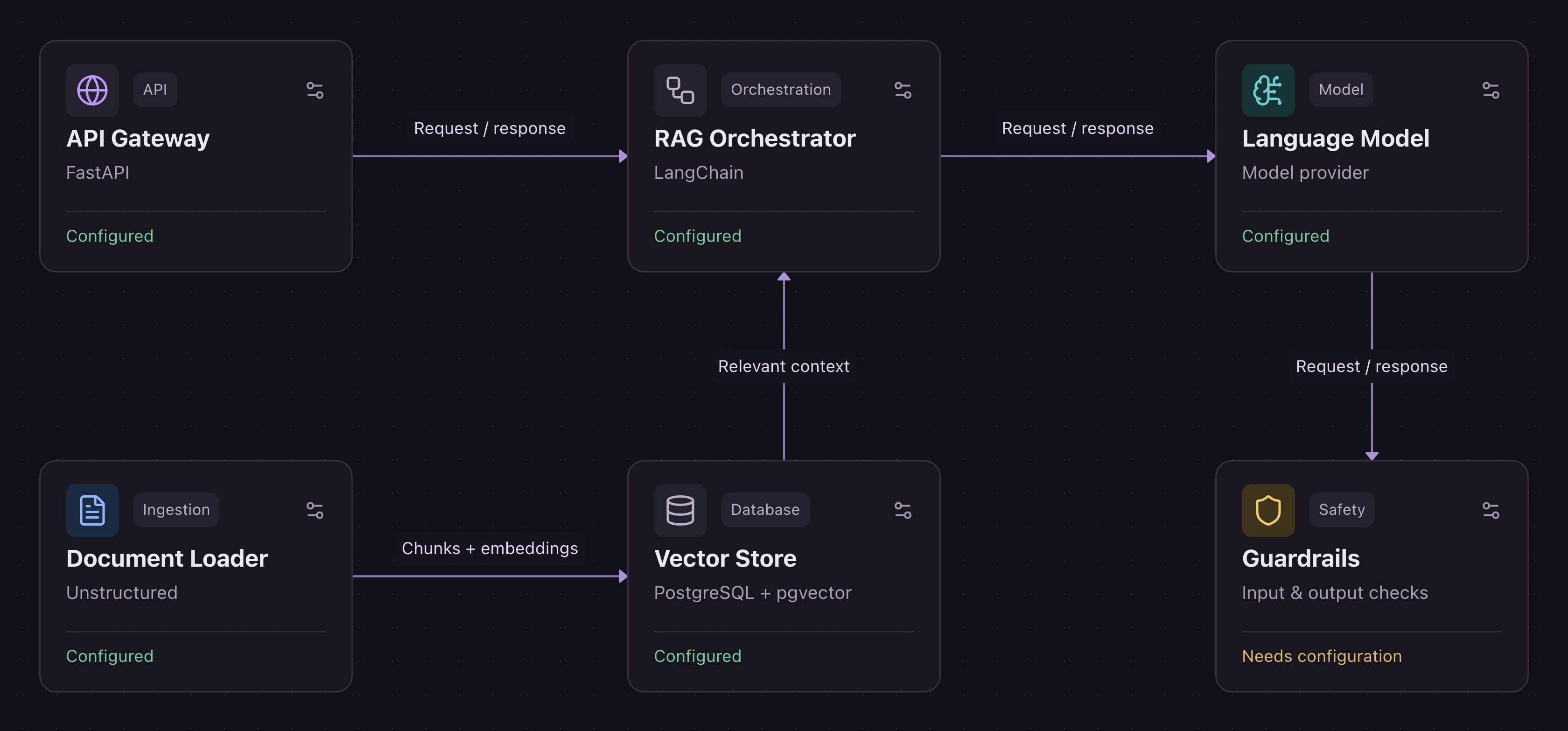
Retrieve relevant context at request time and preserve source metadata for citations. Evaluate retrieval quality before choosing chunk size and top-k.
A starting point for the system you have in mind
The support assistant must answer from approved documentation. Follow that requirement into retrieval, source citations, and the handoff.
A plausible answer is not enough. The brief calls for answers grounded in product documentation, for the support team's real workload.
That requirement leads to retrieval at request time and source metadata for citations. The decision records why, not just which components to connect.
Budget, data sensitivity, and deployment constraints are still unspecified. The review identifies those gaps; it does not certify the design.
The exported report includes the approved-source requirement, the retrieval decision, and the unresolved constraints. The next person gets the reasoning, not just a diagram.
Bring the platforms you already use into the picture. Map how they connect, record the tradeoffs, and hand over a design your team can build.
 Microsoft AzureAzure AI
Map retrieval and model access, then document identity, permissions, and data residency before implementation.
Explore this design AnthropicAnthropic
Connect Claude to your document retrieval layer. Keep source citations, context limits, and evaluation choices beside the design.
Explore this design Google CloudVertex AI / Gemini
Use custom technology fields to map a Google Cloud architecture, with retrieval, model access, and safety checks in view.
Explore this designArchitecture examples, not live integrations. No provider account is connected and no resources are deployed.
Actual product views, from the six-component architecture to its written requirements and technical handoff.
Inspect the sample brief, retrieval decision, and unresolved requirements.
Generated by Archful's own Markdown exporter.
Take an architecture from the first diagram to a documented handoff. Start on your own, manage more projects, or plan for team collaboration.
Two months free with yearly Pro
For individuals shaping their first architectures.
€0
Free on either billing cycle
Try the demoWhat's included:
For architects managing several projects at once.
€29
Per month, billed monthly
Everything in Free, plus:
Exact design allowance to be confirmed.
For teams designing and reviewing architectures together.
Coming soon
Pricing to be announced
Planned additions to Pro:
Team features are planned, not available today.
A little more about designing with Archful.
Archful is a workspace for designing AI architectures. Start with a use case, shape a diagram, document the requirements and decisions, and prepare a technical handoff.
Solution architects, developers, and consultancies designing AI systems for clients or internal teams. It is particularly useful when several people need to understand the reasoning behind a design.
Yes. The current library includes customer support RAG, a knowledge assistant, an agent with tools, and document extraction. Each is a reference to adapt, not a certified production architecture.
You make the architecture decisions. Archful provides an editor, reference patterns, deterministic design checks, and exports. It does not generate or deploy infrastructure.
Yes. Export architecture data as JSON, diagrams as SVG, PNG, or PDF, and handoff documentation as Markdown. The workspace also supports local backups.
Open the workspace and choose a reference pattern or start a new design. This entry saves work in your browser, not to a cloud account. Export a local backup to keep a separate copy.
The proposed Free plan includes two active designs and the complete core workflow: diagrams, requirements, decisions, design checks, and exports. Pro is proposed at €29 per month for more active designs, with the same core tools. Its exact design allowance is still being finalized.
Start with Free for one or two architectures. Pro is intended for keeping more client projects or architecture alternatives active at the same time, rather than unlocking the tools needed to finish a design.
The proposed Pro options are €29 billed monthly or €290 billed yearly. Yearly works out to €24.17 per month and saves €58 compared with twelve monthly payments. Free stays €0 on either cycle. Checkout is not available yet.
Not yet. Checkout is unavailable and no payment is collected. You can use the local demo, which saves work in your browser. The proposed two-design Free limit is not enforced in this demo.